
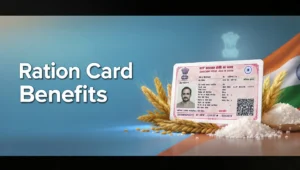
A Ration Card is one of the most important government documents in India. It helps millions of families access subsidized food grains and several welfare services. In this blog, we explain the top benefits of a ration card, eligibility, types, and why every Indian household should have one.
⭐ What is a Ration Card?
A Ration Card is an official document issued by the Government of India that allows households to buy essential food items at subsidized prices under the National Food Security Act (NFSA).
It also works as a valid identity and address proof for many government services.
🟩 Major Benefits of Ration Card in India
1. Subsidized Food Grains Under PDS
Cardholders get essential food grains at very low prices through the Public Distribution System (PDS):
-
Wheat
-
Rice
-
Sugar
-
Kerosene
-
Pulses (varies by state)
This makes ration cards crucial for low-income families.
2. Free Ration Under Government Schemes
During special schemes like Pradhan Mantri Garib Kalyan Anna Yojana (PMGKAY), ration cardholders receive free food grains every month.
This ensures food security during emergencies or economic hardships.
3. Proof of Identity & Address
A ration card acts as a valid document for many official purposes, such as:
-
Applying for Aadhaar
-
Applying for a voter ID
-
Opening a bank account
-
Applying for utility connections
4. Eligibility for Government Schemes
Ration cardholders get access to multiple welfare schemes like:
-
Pension schemes
-
Healthcare benefits
-
LPG subsidies
-
Educational scholarships
Many schemes require ration card details for verification.
5. Priority Household Support
Families with Antyodaya Anna Yojana (AAY) cards receive additional support and higher quantity of food grains.
This helps the poorest of poor families.
6. Easy Access to State Welfare Programs
State governments often provide extra benefits such as:
-
Free school uniforms
-
Mid-day meals
-
Health insurance
-
Special subsidies for women and senior citizens
🟫 Types of Ration Cards in India
1. Antyodaya Anna Yojana (AAY) Card
For the poorest families. They receive the maximum quantity of subsidized food grains.
2. Priority Household (PHH) Card
For families eligible under the National Food Security Act (NFSA).
3. BPL Ration Card
For Below Poverty Line families.
4. APL Ration Card
For Above Poverty Line families (benefits vary by state).
🟦 Who is Eligible for a Ration Card?
Eligibility varies by state, but commonly includes:
✔ Low-income families
✔ Families without an existing ration card
✔ Newly married couples
✔ Residents with valid documents
🟨 How to Apply for a Ration Card?
You can apply both online and offline:
Online Process:
-
Visit your State Food Department Portal
-
Fill application form
-
Upload required documents
-
Submit and track your status
Documents Needed:
-
Aadhaar Card
-
Address Proof
-
Passport-size photo
-
Income Certificate
-
Mobile number
🟩 Conclusion
A ration card is not just a food security document—it is a gateway to government subsidies, identity proof, and essential welfare services. Every eligible Indian family should apply for a ration card to enjoy its full benefits.